1
Which of the following is a chemical change?
💡 Hint:
In which one does a new substance (gas, ash) form?
Explanation:
Coal burns to form CO2 and ash — new substances, so it is chemical. In the other three the substance stays the same.
Class 10 · Science · Chapter 1 · Bihar Board (BSEB)CBSE · NCERT 2026-27
रासायनिक अभिक्रियाएँ एवं समीकरण
How to study this page:
1. Watch — a 30–40 second Short with every lesson
2. Read — easy explanation + a worked example + pictures
3. Check — 2–3 questions; a wrong answer gives a hint, then the explanation
4. Mastery ★ — all check questions right = lesson complete. Fix the wrong ones with “Try again”
5. 5-minute daily review — the “Spaced review” below decides what to revise today
Your progress is saved in this phone/computer's browser (no login).
Last 7 days:
Everything is saved in this phone/browser — no login.
Part 1 — signs, equations, balancing, combination, decomposition, precipitation (~12 min, 17 MB)
Part 2 — displacement, double displacement, redox, corrosion, rancidity (~7 min, 11 MB)
An optional pack for students who want even more practice. It is being prepared now.
All the study material on this page — lessons, videos, 260+ questions with answers and PDFs — will always stay free.
रासायनिक अभिक्रिया क्या है? भौतिक बनाम रासायनिक परिवर्तन · NCERT Introduction
Look around you — milk left out in summer turns sour, an iron pan or nail rusts in moist air, grapes ferment, food gets cooked, our body digests food and we breathe. In all of these, the nature and identity of the starting substance changes.
When a new substance forms, we call it a chemical change, and the process by which it happens is called a chemical reaction.
| Basis | Physical change | Chemical change |
|---|---|---|
| Does a new substance form? | No — the substance stays the same | Yes — a new substance forms |
| Reversing it | Usually easy (ice ↔ water) | Usually hard (curd does not turn back into milk) |
| Examples | Ice/wax melting, salt dissolving, folding paper | Milk → curd, burning coal, rusting, digestion |
Ice → water = a physical change (H2O stays the same). Milk → curd = a chemical change (lactose, the sugar in milk, turns into lactic acid).
Burning a candle — it has both! Wax melting = physical; wax burning at the wick to form CO2 and water vapour = chemical.
Dissolving sugar in water — physical (evaporate the water and you get the sugar back).
Digestion of food — chemical (food breaks down into new substances such as glucose).
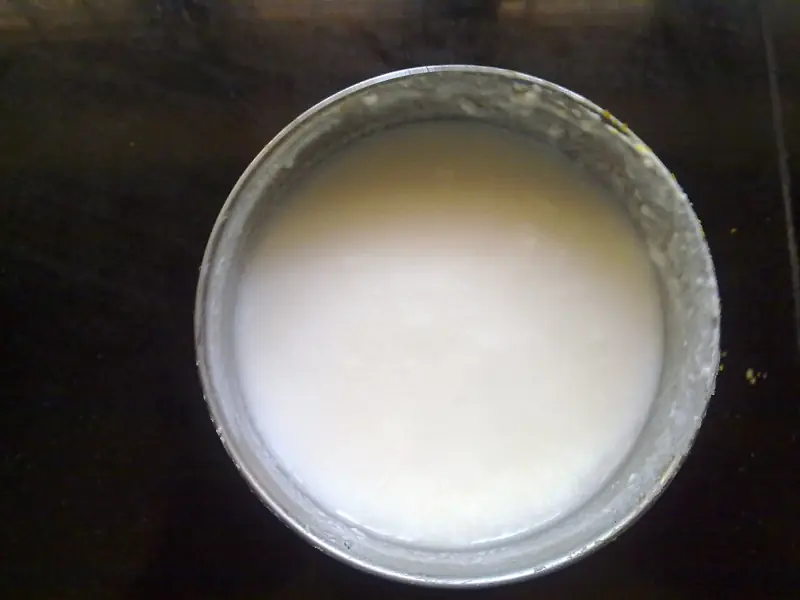
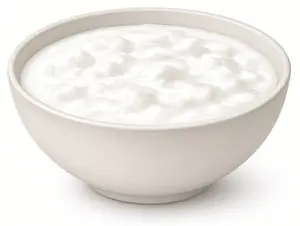
Objective questions often ask “Which is a chemical change?” — check whether a new substance forms. Milk to curd, rusting, digestion = chemical; ice melting, water boiling = physical.
CBSE asks situation-based questions: “A cut apple turns brown — physical or chemical change? Give a reason.” Always write the evidence (change in colour / smell / gas / temperature).
In which one does a new substance (gas, ash) form?
Coal burns to form CO2 and ash — new substances, so it is chemical. In the other three the substance stays the same.
H2O changed from solid to liquid — same substance, only the state changed. This is a physical change.
Ask — did a new substance form or not?
The taste (sour) and texture of curd change because a new substance forms; it cannot be turned back into milk.
क्रियाकलाप 1.1 — मैग्नीशियम रिबन का जलना · NCERT Activity 1.1 · In-text Q 1
Clean a 3–4 cm long magnesium ribbon by rubbing it with sandpaper, hold it with tongs, burn it over a spirit lamp or burner and collect the ash in a watch-glass.
What do you see? The ribbon burns with a dazzling white flame and a white powder is left — this is magnesium oxide (MgO).
Why rub it? Magnesium kept in air slowly gets coated with a layer of MgO. This layer stops Mg from meeting oxygen, so the ribbon does not burn properly. Rubbing removes the layer and exposes shiny Mg.
Safety: hold the ribbon with tongs, keep the burning ribbon away from your eyes and do not stare at its bright light for long.
Question: Why should a magnesium ribbon be cleaned before burning it in air?
Answer: Oxygen in the air forms a layer of magnesium oxide on the magnesium ribbon, which hinders burning. Rubbing with sandpaper removes this layer, so pure Mg reacts directly with oxygen and burns easily.
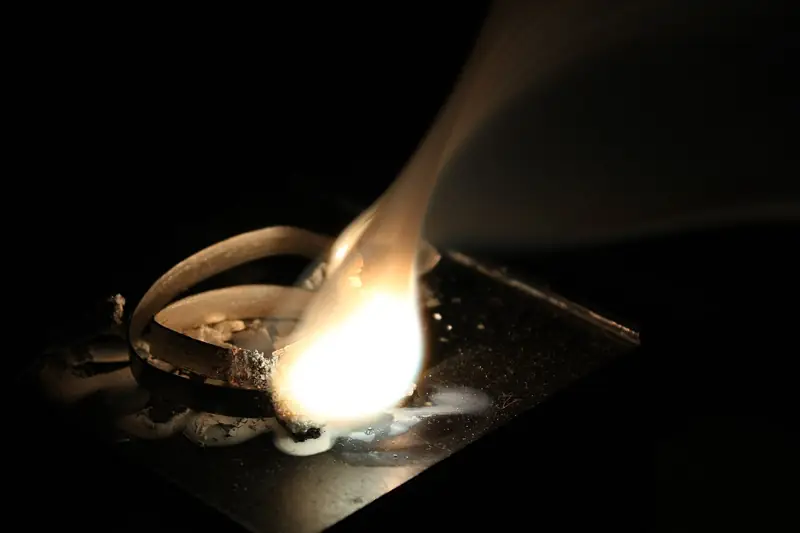
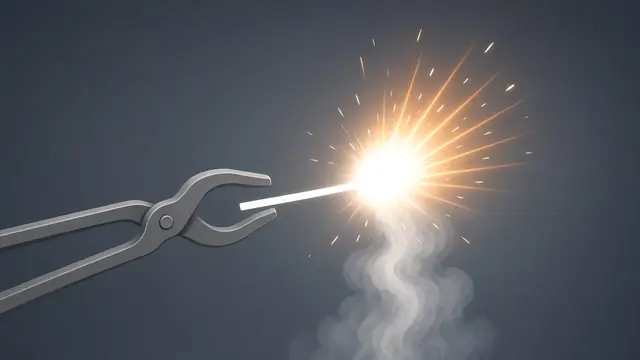
For the 2-mark question “Why is a magnesium ribbon cleaned with sandpaper before burning?” remember one line: to remove the layer of MgO / carbonate so that Mg combines directly with oxygen.
Write it as observation → conclusion: dazzling white flame + white powder → a new substance, MgO, has formed. Add the balanced equation 2Mg + O₂ → 2MgO.
Mg combines with oxygen in the air to form magnesium oxide (MgO) — a white powder.
Which layer forms on a ribbon kept in air?
The MgO layer stops oxygen from reaching Mg; rubbing removes the layer and the ribbon burns properly.
There are 2 O atoms on the left — what will you put before MgO on the right? Then equalise Mg.
O: 2 = 2, Mg: 2 = 2 ✓
क्रियाकलाप 1.2, 1.3 और अभिक्रिया के संकेत · NCERT Activity 1.2, 1.3
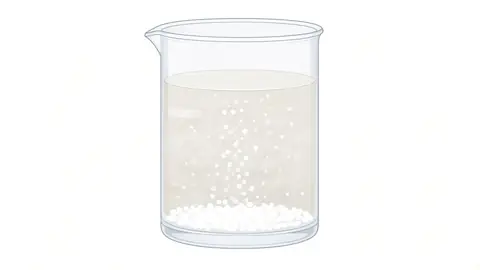
Add a colourless solution of potassium iodide to a colourless solution of lead nitrate — a bright yellow precipitate forms at once. This is lead iodide (PbI2).
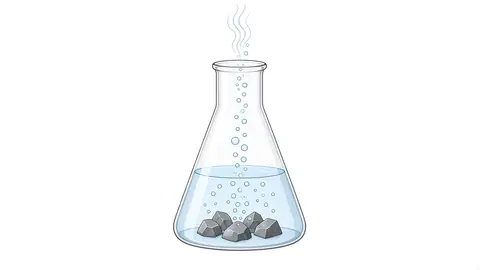
Take zinc granules in a conical flask and add dilute sulphuric acid (or dilute hydrochloric acid) — bubbles (H2 gas) form around the zinc and the flask becomes warm. Bring a burning splinter near it: a “pop” sound = the test for hydrogen.
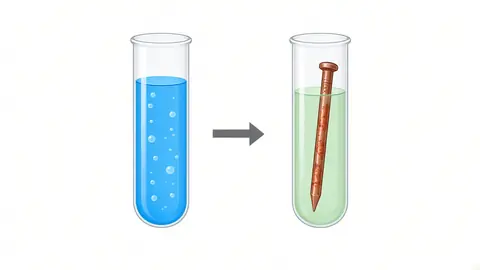
(i) Change in colour — when an iron nail is put in CuSO4 solution, the blue colour turns pale green.
(ii) Evolution of a gas — bubbles of H2 when dilute H2SO4 is poured on Zn.
(iii) Change in temperature — the beaker becomes hot when water is added to CaO.
(iv) Formation of a precipitate — yellow solid PbI2 from Pb(NO3)2 + KI.
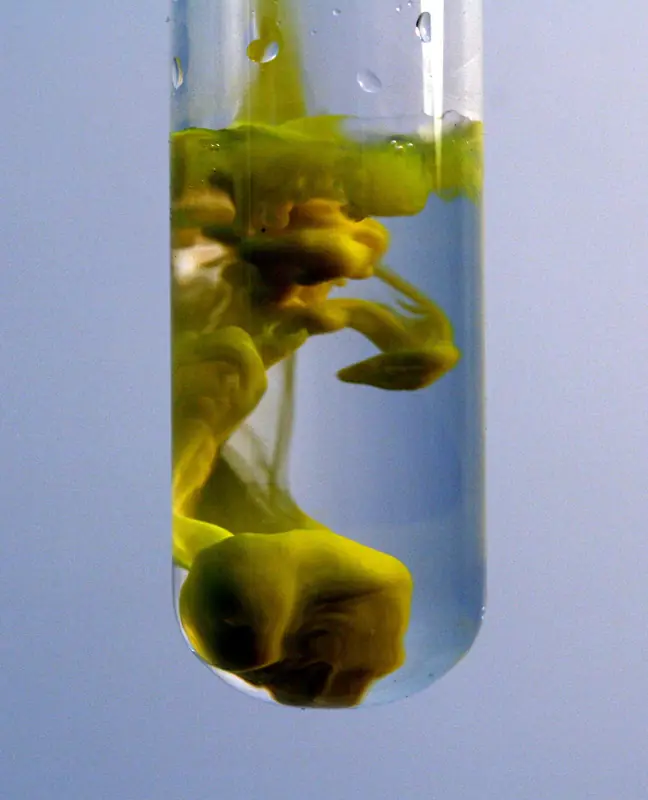
The list of four signs of a reaction (change of state, change of colour, gas evolved, change in temperature) helps in both objective and short answers — remember one example of each.
A question may say: “The test tube became warm and bubbles appeared — what do you conclude?” → an exothermic reaction and a gas formed. Link each sign to its reason.
Lead iodide (PbI2) is a bright yellow insoluble solid.
Hydrogen gas burns in air...
H₂ burns with a “pop” sound near a burning splinter. Lime water turning milky is the test for CO2.
Cutting only changed the shape; no new substance formed — a physical change.
रासायनिक समीकरण — शब्द से सूत्र तक · NCERT 1.1, 1.1.1
A short and clear way of writing a reaction = a chemical equation.
2. Formula equation — write chemical formulae instead of words:
Now count the atoms — 2 O atoms on the left, only 1 on the right. The atoms are not equal on both sides, so the equation is unbalanced. Such an unbalanced formula equation is called a skeletal chemical equation.
Words: zinc + sulphuric acid → zinc sulphate + hydrogen
Formulae: Zn + H2SO4 → ZnSO4 + H2
Count: Zn 1 = 1 · H 2 = 2 · S 1 = 1 · O 4 = 4 → it is already balanced.
Questions that turn a word equation into a formula equation come up directly. Reactants on the left, products on the right, an arrow (→) and “+” in between — never use “=”.
Learn to spot a skeletal equation — CBSE may ask “Why does this equation not obey the law of conservation of mass?” → the atoms are not equal on both sides.
Reactants on the left, products on the right.
A formula equation in which the number of atoms is not equal on both sides is a skeletal equation.
Look at the small number written below in O2.
O2 = 2 atoms of oxygen; only 1 in MgO on the right — so it is unbalanced.
संतुलित समीकरण — क्यों और कैसे? · NCERT 1.1.2
mass can neither be created nor destroyed in a chemical reaction. That means atoms are neither made nor lost; they only join up in new ways. So the number of atoms of each element must be equal on both sides. Such an equation is called a balanced chemical equation.
Guess → count → correct — this is called the hit-and-trial method. Coefficients must always be the smallest whole numbers.
| Element | Left | Right |
|---|---|---|
| Fe | 1 | 3 |
| H | 2 | 2 |
| O | 1 | 4 |
Step 1 — O (biggest compound Fe3O4, O = 4 in it): 4 in front of H₂O → Fe + 4H2O → Fe3O4 + H2
Step 2 — H: now H = 8 on the left, so 4 in front of H₂ on the right → Fe + 4H2O → Fe3O4 + 4H2
Step 3 — Fe: Fe = 3 on the right, so 3Fe on the left →
Check: Fe 3 = 3 · H 8 = 8 · O 4 = 4 ✓ balanced.
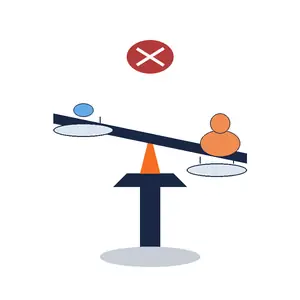
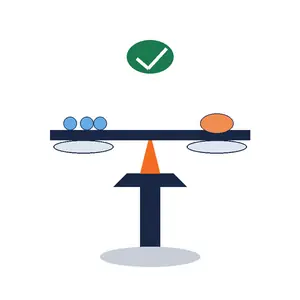
“Why must a chemical equation be balanced?” — answer: the law of conservation of mass; atoms are neither created nor destroyed. This is a favourite 2-mark question.
While balancing, never change a formula (subscript), change only the coefficients — CBSE assertion–reason questions are built on exactly this.
Conservation of mass: the total mass (and the number of atoms) does not change in a reaction.
Nothing inside the formula changes — the number goes in front of the formula.
The coefficient goes in front of the formula: 4H2O. H2O4 would be a completely different substance.
First equalise O (4 O in Fe3O4), then H, and finally Fe.
Fe 3 = 3, H 8 = 8, O 4 = 4 ✓
संतुलन का अभ्यास — आसान से कठिन · NCERT In-text Q 2 · Exercise 5, 6
H2 + Cl2 → 2HCl
2Na + 2H2O → 2NaOH + H2
if groups like SO4, NO3, OH stay the same on both sides, count each as one “block”.
3BaCl2 + Al2(SO4)3 → 3BaSO4 + 2AlCl3
(SO₄ block: 3 on the left, 3 on the right · Ba 3 = 3 · Al 2 = 2 · Cl 6 = 6)
2HNO3 + Ca(OH)2 → Ca(NO3)2 + 2H2O
2NaOH + H2SO4 → Na2SO4 + 2H2O
BaCl2 + H2SO4 → BaSO4 + 2HCl
first the word equation, then formulae, then balancing.
- Nitrogen + hydrogen → ammonia: N2 + 3H2 → 2NH3
- Burning of hydrogen sulphide in air: 2H2S + 3O2 → 2H2O + 2SO2
- Potassium + water: 2K + 2H2O → 2KOH + H2
Whenever you write an equation in the exam, write it balanced — unbalanced equations lose marks. At the end, count the atoms of each element on both sides.
Reactions given in words (“barium chloride + sodium sulphate …”) must be converted to formulae and balanced yourself — practise two such statements every day.
For the 2 H of H2, both NaOH and H₂O must become 2.
Na 2 = 2, H 4 = 4, O 2 = 2 ✓
Treat SO₄ as one block: Al2(SO4)3 has 3 SO₄ → 3BaSO₄.
Ba 3 = 3, SO₄ 3 = 3, Al 2 = 2, Cl 6 = 6 ✓
2 atoms of N → 2NH₃; then count H.
N 2 = 2, H 6 = 6 ✓
अवस्था संकेत और तीर पर लिखी शर्तें · NCERT 1.1.2 (step VII) · In-text Q 3
To make an equation more informative, we write the physical state of each substance next to it:
| Symbol | Meaning | Example |
|---|---|---|
| (s) | solid | Fe(s), MgO(s) |
| (l) | liquid | H2O(l) |
| (g) | gas | O2(g), steam = H2O(g) |
| (aq) | aqueous solution — dissolved in water | NaCl(aq), CuSO4(aq) |
| ↑ | gas given off | H2↑ |
| ↓ | precipitate formed | BaSO4↓ |
Note — water in the form of steam (a gas) is written as H2O(g):
State symbols are usually written only when necessary or when the question asks for them.
conditions such as temperature, pressure, a catalyst or light are written on the arrow —
CO(g) + 2H2(g) 340 atm→ CH3OH(l)
6CO2(aq) + 12H2O(l) sunlight→chlorophyll C6H12O6(aq) + 6O2(aq) + 6H2O(l)
(i) Aqueous solutions of barium chloride and sodium sulphate → insoluble barium sulphate + a solution of sodium chloride:
BaCl2(aq) + Na2SO4(aq) → BaSO4(s) + 2NaCl(aq)
(ii) Sodium hydroxide solution + hydrochloric acid solution → sodium chloride solution + water:
NaOH(aq) + HCl(aq) → NaCl(aq) + H2O(l)
Trick: “insoluble / precipitate” → (s) · “solution” → (aq) · pure water → (l) · steam → (g)
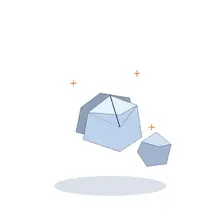
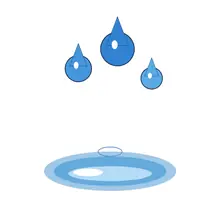
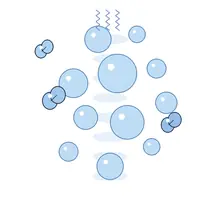
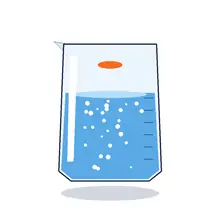
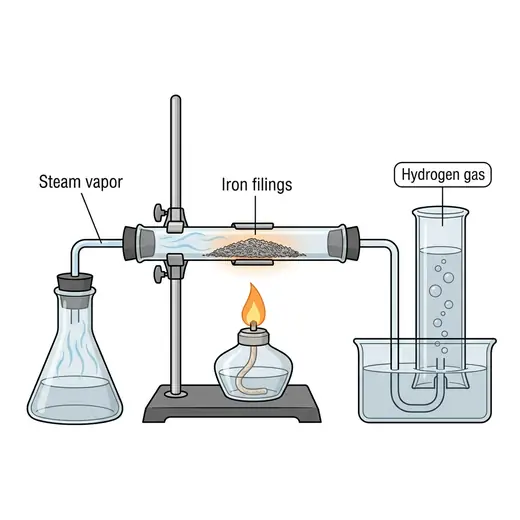
The meanings of (s), (l), (g), (aq) are asked in objective questions — (aq) = aqueous solution. Remember to write temperature, pressure or catalyst above/below the arrow.
If a full equation with state symbols is asked, put a symbol with every substance, e.g. Zn(s) + H₂SO₄(aq) → ZnSO₄(aq) + H₂(g).
Steam is a gas, so H2O(g) — as in 3Fe(s) + 4H2O(g) → Fe3O4(s) + 4H2(g)
BaSO₄ does not dissolve in water — it forms a precipitate.
An insoluble precipitate = solid, so BaSO4(s).
Conditions such as temperature, pressure, a catalyst or light are written above/below the arrow.
अभिक्रियाओं के प्रकार और संयोजन अभिक्रिया · NCERT 1.2, 1.2.1 · Activity 1.4 · In-text Q (substance X)
In a reaction, atoms are neither destroyed nor created, and one element does not change into another — only the bonds between atoms break and new ones form. Reactions are classified on this basis (see the figure below).
when two or more substances (elements or compounds) combine to form a single product.
Take a little calcium oxide (quicklime) in a beaker and slowly add water — the beaker becomes very hot and slaked lime (calcium hydroxide) forms.
a solution of slaked lime is applied to walls. It slowly reacts with CO2 in the air and forms a thin layer of calcium carbonate on the wall — after 2–3 days the wall starts to shine. (The chemical formula of marble is also CaCO3.)
(i) X = calcium oxide (quicklime), formula CaO.
(ii) Reaction with water — slaked lime forms and a lot of heat is released:
CaO(s) + H2O(l) → Ca(OH)2(aq) + heat
Note: the solution applied to the wall is slaked lime, Ca(OH)2; so some books write “X = slaked lime”. But part (ii) asks for “the reaction of X with water” — which only applies to CaO.
The whitewash question (quicklime + water) comes again and again: CaO + H₂O → Ca(OH)₂ + heat; on the wall, CO₂ forms a shiny layer of CaCO₃.
In the “substance X” puzzle, X = CaO and slaked lime is Ca(OH)₂ — write both equations along with the identification.
Quicklime = CaO (calcium oxide); slaked lime = Ca(OH)2.
Which gas in the air does Ca(OH)₂ slowly react with?
Ca(OH)2(aq) + CO2(g) → CaCO3(s) + H2O(l) — a thin layer of CaCO₃ gives the shine.
Two → one; heat is given out on burning; C gains O.
Burning of coal = combination + exothermic; carbon is oxidised (gain of O).
ऊष्माक्षेपी अभिक्रियाएँ — श्वसन, दहन, कंपोस्ट · NCERT 1.2.1 · Exercise 10
Reactions in which heat is given out along with the formation of products are called exothermic reactions. The beaker getting hot in the CaO + water reaction is an example.
Food (carbohydrates in rice, potatoes, bread) is broken down into glucose during digestion. In the cells, glucose reacts with oxygen to form CO2 and water, and energy is released — this energy lets the body work and keeps it warm. Since energy is given out, respiration is an exothermic reaction.
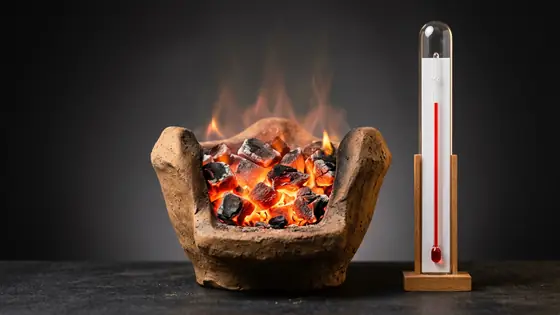
“Why is respiration called an exothermic reaction?” — glucose is oxidised and energy is released: C₆H₁₂O₆ + 6O₂ → 6CO₂ + 6H₂O + energy.
Connect exothermic examples to daily life — compost heating up, natural gas burning; case-based questions ask exactly this.
In which one does the container get hot by itself?
A lot of heat is released in CaO + water. The other three are decompositions that need energy (endothermic).
In respiration, oxidation of glucose releases energy — exothermic.
First equalise H (4 H of CH4 → 2H₂O), then count O.
C 1 = 1, H 4 = 4, O 4 = 4 ✓
वियोजन (अपघटन) — ऊष्मा से · NCERT 1.2.2 · Activity 1.5, 1.6
When a single reactant breaks down into two or more simpler products, it is called a decomposition reaction. Decomposition caused by heating = thermal decomposition.
Heat about 2 g of green ferrous sulphate crystals (FeSO4·7H2O) in a dry test tube. First the water of crystallisation is lost and the colour changes; on further heating it breaks down — there is a smell of burning sulphur.
(Fe2O3 = ferric oxide, a reddish-brown solid)
heating calcium carbonate gives quicklime, one use of which is in making cement.
heating lead nitrate powder gives off brown fumes — this is nitrogen dioxide (NO2).
One reactant on the left + two or more products on the right = decomposition.
CaCO3(s) heat→ CaO(s) + CO2(g) — 1 → 2 ✓
2Pb(NO3)2(s) heat→ 2PbO(s) + 4NO2(g) + O2(g) — 1 → 3 ✓
(A coefficient of 2 does not make it “two” reactants — it is still one substance.)
Heating ferrous sulphate turns it green → white/brown with a smell of burning sulphur — this observation question is common. With lead nitrate, remember the brown fumes (NO₂).
Practise one balanced equation for each thermal decomposition: CaCO₃ → CaO + CO₂ (used in the lime industry).
Nitrogen dioxide (NO2) is a brown, poisonous gas; O2 is colourless.
2FeSO4(s) heat→ Fe2O3(s) + SO2(g) + SO3(g) — the smell of the oxides of sulphur.
One → two; heat has to be supplied; nothing gains or loses O.
Thermal decomposition, endothermic; no oxidation or reduction.
वियोजन — विद्युत और प्रकाश से · NCERT Activity 1.7, 1.8 · In-text Q 2 · Exercise 11, 12
Fix carbon electrodes in a plastic mug and connect them to a 6 V battery. Fill the mug with water + a few drops of dilute sulphuric acid and invert test tubes filled with water over both electrodes. When the current flows, bubbles form at both electrodes.
Why is there twice as much gas in one tube? In water (H2O) every O atom has two H atoms, so the volume of hydrogen formed is double that of oxygen (2 : 1). Tests: H2 — a burning splinter burns with a “pop”; O2 — a candle burns more brightly.
Keep white silver chloride in a china dish in sunlight — after some time it turns grey, because silver metal forms.
2AgCl(s) sunlight→ 2Ag(s) + Cl2(g)
2AgBr(s) sunlight→ 2Ag(s) + Br2(g)
These reactions are used in black-and-white photography — that is why AgCl/AgBr are kept in dark-coloured bottles.
combination is many → one; decomposition is one → many.
| Combination (many → one) | Decomposition (one → many) |
|---|---|
| 2H2 + O2 → 2H2O | 2H2O → 2H2 + O2 |
| CaO + CO2 → CaCO3 | CaCO3 → CaO + CO2 |
In the electrolysis of water, H₂ at the cathode and O₂ at the anode, volume ratio 2 : 1 — this was asked in the 2025 board paper too. Remember the decomposition of AgBr / AgCl by light in black-and-white photography.
Data question: “20 mL of gas at the cathode — how much at the anode?” → 10 mL of O₂. Combination and decomposition are opposites — this comparison is asked.
How many H and O are there in the formula H₂O?
In H₂O, H : O = 2 : 1, so the volume of H₂ is double that of O₂.
Decomposition by light: 2AgCl(s) sunlight→ 2Ag(s) + Cl2(g) — the silver formed looks grey.
One in which a single substance breaks down into many.
Combination: many → one; decomposition: one → many.
ऊष्माशोषी अभिक्रियाएँ और सामूहिक क्रियाकलाप · NCERT 1.2.2 · Exercise 9 · group activity
In decomposition, energy has to be supplied as heat, light or electricity to break the reactant. Reactions in which energy is absorbed (taken in) are called endothermic reactions.
Take about 2 g of barium hydroxide in a test tube, add 1 g of ammonium chloride and stir with a glass rod. Touch the bottom of the test tube — it feels cold! Heat was taken from the surroundings = endothermic.
| Exothermic 🔥 | Endothermic ❄️ |
|---|---|
| Heat is given out | Energy is taken in |
| The container gets hot | The container gets cold (or energy must be supplied continuously) |
| CaO + water, burning, respiration, compost | Decomposition of CaCO₃, AgCl in sunlight, electrolysis of water, photosynthesis |
Take four beakers A, B, C, D — 25 mL of water in A, B, C and copper sulphate solution in D. Note the temperature. Then add potassium sulphate to A, ammonium nitrate to B, anhydrous copper sulphate to C and fine iron powder to D, stir, and note the temperature again.
| Beaker | What was added | What is usually seen | Conclusion |
|---|---|---|---|
| A | K2SO4 | temperature falls slightly | endothermic |
| B | NH4NO3 | temperature falls a lot (cold) | endothermic |
| C | anhydrous CuSO4 | temperature rises (hot) | exothermic |
| D | Fe powder (in CuSO4 solution) | temperature rises | exothermic |
Write down what your thermometer actually showed — the change in A may be very small. (In A, B, C a salt dissolves/gets hydrated; D is a displacement reaction: Fe(s) + CuSO4(aq) → FeSO4(aq) + Cu(s))
Exothermic: reactions in which heat is given out along with the products. Example: CH4(g) + 2O2(g) → CO2(g) + 2H2O(g)
Endothermic: reactions in which energy is absorbed. Example: CaCO3(s) heat→ CaO(s) + CO2(g)
Write the difference between exothermic and endothermic as a table (2 marks) — examples: respiration (exothermic), photosynthesis / decomposition of CaCO₃ (endothermic).
Experiment-based question: “The beaker became cold when barium hydroxide and ammonium chloride were mixed” → endothermic. The temperature change is the evidence.
Heat was taken from the surroundings (your hand), so it feels cold — endothermic.
Heat, light or electrical energy has to be supplied to break the reactant.
Do plants take in or give out the energy of sunlight?
Plants absorb the energy of sunlight to make glucose — endothermic.
विस्थापन अभिक्रिया और सक्रियता श्रेणी · NCERT 1.2.3 · Activity 1.9 · In-text Q 1 · Exercise 2, 3, 7, 14
When a more reactive element removes a less reactive element from its compound, it is called a displacement reaction: A + BC → AC + B
Dip iron nails cleaned with sandpaper in blue copper sulphate solution for about 20 minutes. A brown coating (copper) forms on the nails and the blue colour of the solution fades to pale green (ferrous sulphate forms).
Metal + dilute acid → salt + hydrogen (this is also displacement — the metal displaces H from the acid):
Fe(s) + 2HCl(aq) → FeCl2(aq) + H2(g)
Mg(s) + 2HCl(aq) → MgCl2(aq) + H2(g)
Fe2O3 + 2Al → Al2O3 + 2Fe — Al removes Fe from iron oxide = a displacement reaction (also redox: Al is oxidised, Fe2O3 is reduced). It is not combination or double displacement.
Iron is more reactive than copper. It displaces copper from CuSO4 and forms ferrous sulphate, whose solution is pale green; so the blue colour fades and brown copper deposits on the nail.
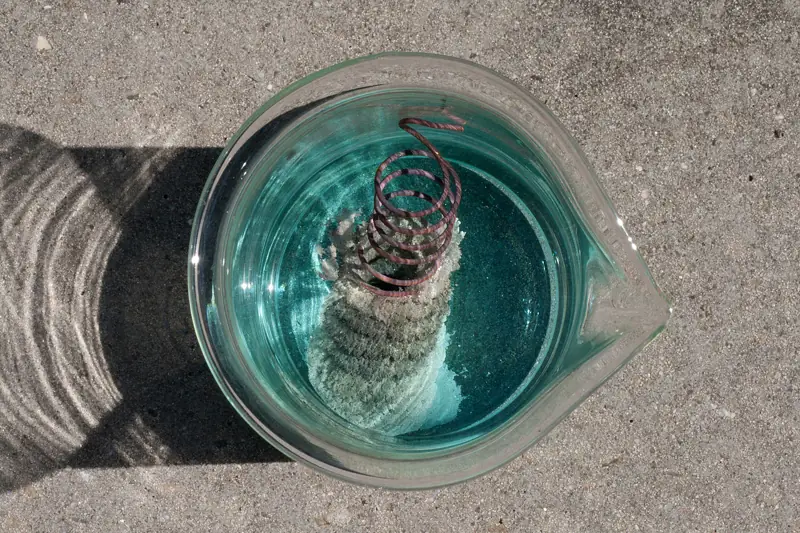
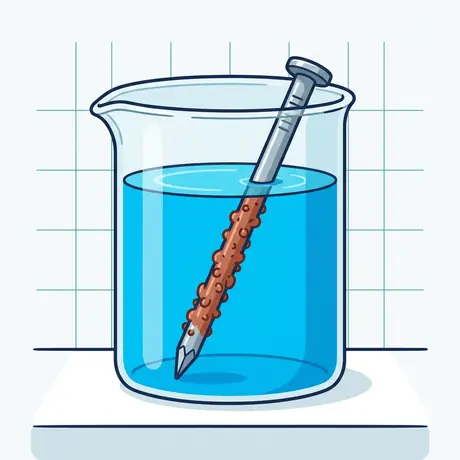
Iron nail + copper sulphate: blue colour fades / turns pale green, brown coating on the nail — remember both the observation and the equation Fe + CuSO₄ → FeSO₄ + Cu.
Reason with reactivity: “Can Cu displace Fe from FeSO₄?” → no, Cu is less reactive. Such reasoning questions are common in CBSE.
Which one is above Cu in the reactivity series?
Zn is more reactive than Cu: Zn(s) + CuSO4(aq) → ZnSO4(aq) + Cu(s). Ag, Au, Pt are less reactive than Cu.
Cu is less reactive than Fe, so it cannot displace Fe — no reaction.
What did Al push out? What gained O and what lost O?
Al displaced Fe = displacement; a lot of heat is given out (thermite, used to join rails); Al is oxidised, Fe₂O₃ is reduced = redox.
द्विविस्थापन, अवक्षेपण और उदासीनीकरण · NCERT 1.2.4 · Activity 1.10 · In-text Q 2 · Exercise 13, 15
Mix barium chloride solution with sodium sulphate solution — a white precipitate forms. This is barium sulphate, which is insoluble in water; sodium chloride stays dissolved.
Here Ba2+ and SO42- ions combine to form BaSO4 — the two reactants exchanged ions. Such a reaction = double displacement: AB + CD → AD + CB
A reaction in which a precipitate (an insoluble solid) forms is called a precipitation reaction — precipitation reactions produce insoluble salts.
acid + base → salt + water (the full topic is in Chapter 2)
| Displacement | Double displacement |
|---|---|
| One element removes another element from a compound | Two compounds exchange ions |
| A + BC → AC + B | AB + CD → AD + CB |
| Fe + CuSO4 → FeSO4 + Cu | Na2SO4 + BaCl2 → BaSO4 + 2NaCl |
(i) The precipitate is yellow; the compound is lead iodide (PbI2).
(ii) Pb(NO3)2(aq) + 2KI(aq) → PbI2(s) + 2KNO3(aq)
(iii) Yes, it is double displacement — Pb2+ and K+ exchanged their partner ions (NO3- and I-).
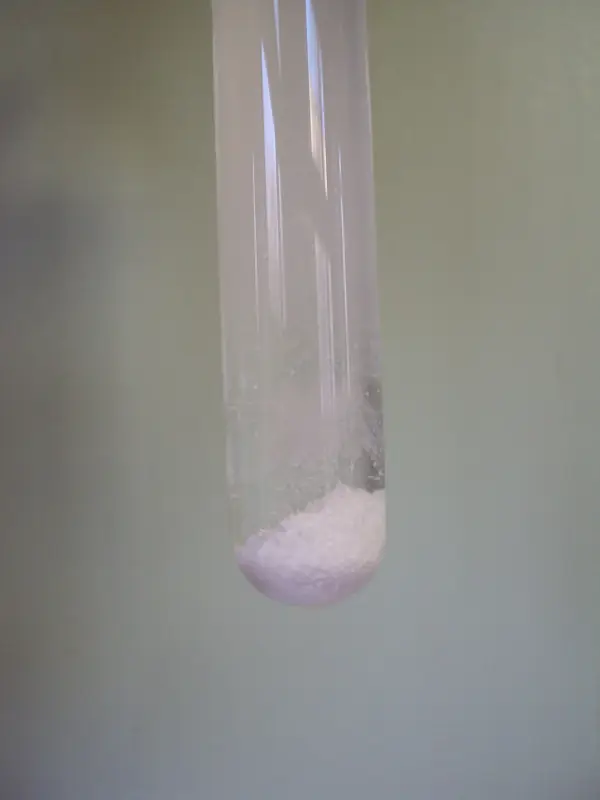
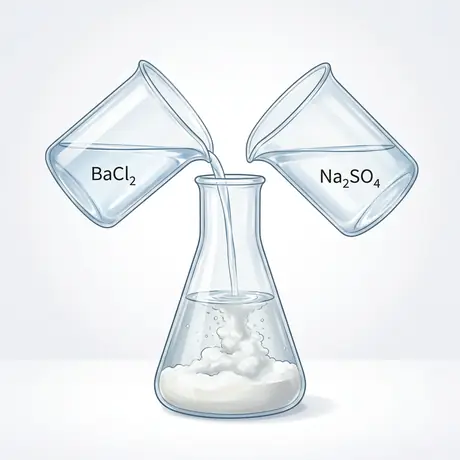
“Explain a precipitation reaction with an example” — this came in the 2025 board paper. Write Na₂SO₄ + BaCl₂ → BaSO₄↓ (white) + 2NaCl.
In double displacement, show the exchange of ions; do not forget ↓ or (s) for the precipitate.
AB + CD → AD + CB — exchange of ions.
Which product gets (s)?
AgNO3(aq) + NaCl(aq) → AgCl(s) + NaNO3(aq) — AgCl is an insoluble white precipitate; NaNO3 stays dissolved.
Acid + base → salt + water = neutralisation; ions are exchanged.
Neutralisation = double displacement; heat is given out; no oxidation/reduction by O or H.
उपचयन (ऑक्सीकरण), अपचयन और रेडॉक्स · NCERT 1.2.5 · Activity 1.11 · In-text Q 3 · Exercise 1, 16, 17
Heat about 1 g of copper powder in a china dish — the shiny brown copper turns black. Copper gains oxygen and copper(II) oxide forms:
Now pass hydrogen gas over this hot black CuO — the black coating turns brown again, because copper is formed back:
Here CuO is losing oxygen = reduction; H2 is gaining oxygen = oxidation. One substance oxidised and another reduced at the same time = an oxidation–reduction (redox) reaction.
| In terms of oxygen | In terms of hydrogen | |
|---|---|---|
| Oxidation | gain of oxygen (+O) | loss of hydrogen (−H) |
| Reduction | loss of oxygen (−O) | gain of hydrogen (+H) |
the substance that is itself reduced while oxidising another = the oxidising agent; the one that is itself oxidised while reducing another = the reducing agent. In CuO + H2 → Cu + H2O: CuO = oxidising agent, H2 = reducing agent.
The incorrect statements are (a) and (b) → answer (i)
Objective questions on identifying the substance oxidised / reduced appear almost every year — rule: gain of oxygen / loss of hydrogen = oxidation; the reverse = reduction.
For an equation like ZnO + C → Zn + CO, write all four: what is oxidised, what is reduced, the oxidising agent and the reducing agent.
Which one gained oxygen?
H₂ gained O (formed H₂O) = oxidation; CuO lost O = reduction.
Oxidation = gain of O or loss of H (as in HCl → Cl₂).
Na gained oxygen — Na is oxidised (NCERT in-text question 3(i)).
संक्षारण — लोहे में जंग और बचाव · NCERT 1.3.1 · Exercise 18, 20(a)
New iron things are shiny, but after some time a reddish-brown flaky layer forms on them — this is called rusting. When a metal is slowly eaten away by substances around it — moisture, acids and so on — it is called corrosion.
Rusting needs both air (oxygen) and moisture. In simple form:
car bodies, bridges, iron railings, ships and all things made of iron become weak; a lot of money is spent every year to replace rusted iron.
paint forms a layer on the iron surface and keeps it away from air and moisture, so it does not rust. Other methods: applying oil/grease, galvanisation (a coating of zinc), chrome plating, making alloys (more in Chapter 3).
Corrosion: a metal being slowly destroyed by moisture, air, acids, etc.
Example: rusting of iron — a reddish-brown layer (Fe2O3·xH2O) forms on iron in moist air. Silver turning black and the green coating on copper are also examples of corrosion.
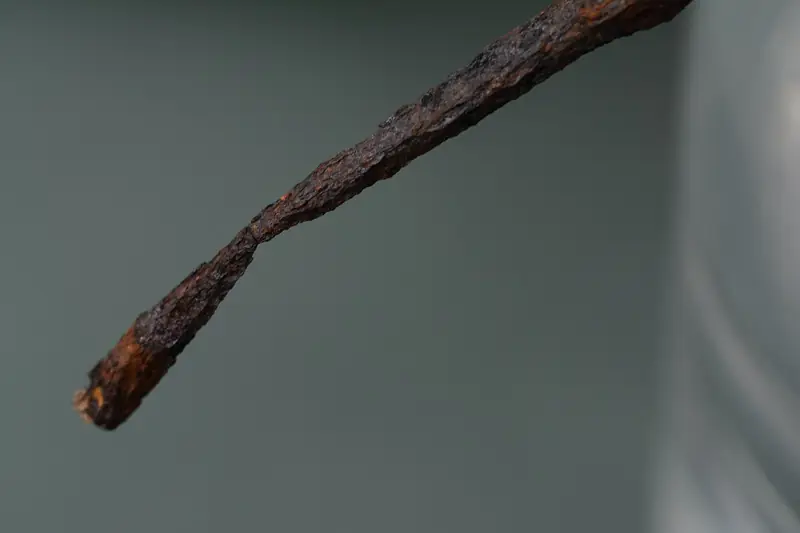
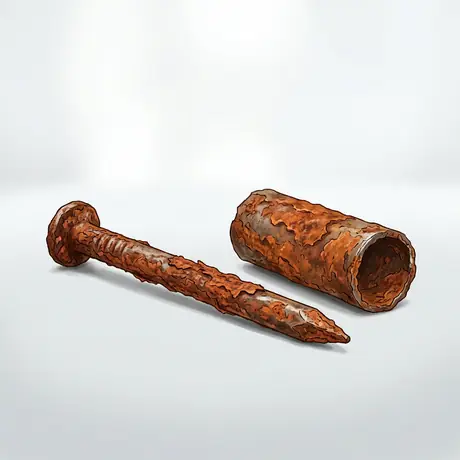
Definition of corrosion + 3 ways to prevent rusting (paint, oil/grease, galvanising) — a sure 2–3 mark question.
A case question may ask: “Why do iron railings in a seaside town rust faster?” → more moisture and salt in the air.
Iron does not rust in dry air or in boiled (O₂-free) water — both are needed.
Galvanisation (a zinc coating) protects iron from rusting.
A black coating forms on silver due to sulphur compounds in the air — this is also corrosion.
विकृतगंधिता — चिप्स के पैकेट में नाइट्रोजन क्यों? · NCERT 1.3.2 · Exercise 19, 20(b)
If oily or fatty foods (chips, namkeen, ghee, butter) are left open for a long time, their taste and smell change. This happens because fats and oils get oxidised by oxygen in the air — this is called rancidity.
Chip packets are filled with nitrogen, not air, so that the chips do not get oxidised.
So that no oxygen stays in the packet. Nitrogen is an unreactive gas — it does not react with oils/fats. So they are not oxidised and rancidity (going stale) is prevented.
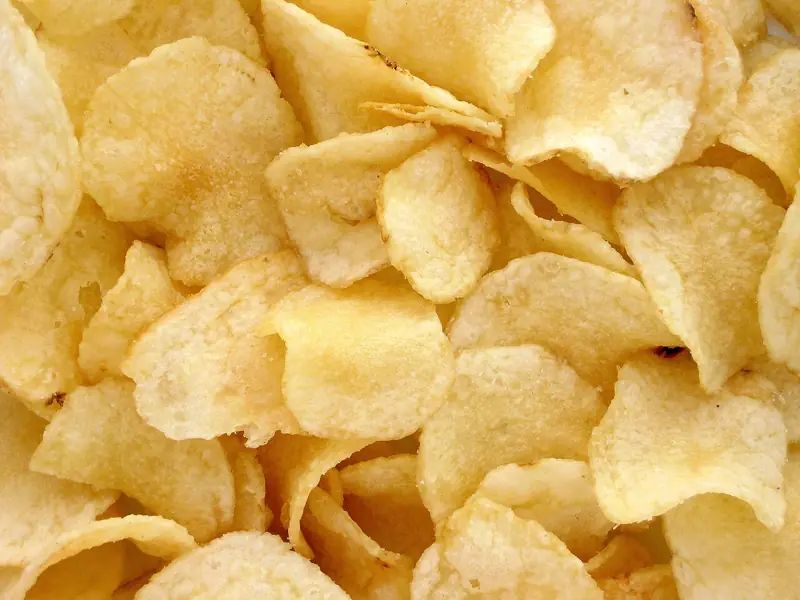
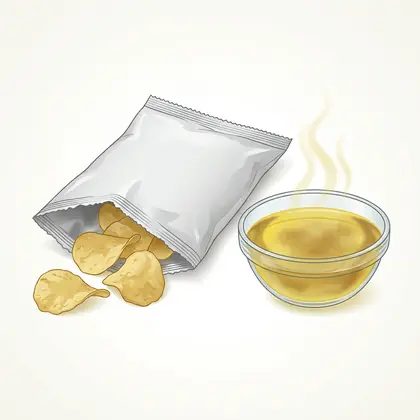

Definition of rancidity + ways to prevent it: flushing with nitrogen, adding antioxidants, airtight containers, refrigeration.
Answer “Why nitrogen in chip packets?” with reasoning: nitrogen is unreactive, oxygen is removed, so the oil is not oxidised.
N₂ removes the oxygen → the oil is not oxidised → the chips do not go stale.
Oxidation of fats/oils by oxygen in the air.
They work “against” oxidation.
Antioxidants prevent oxidation.
बोर्ड रिवीजन — पूरा अध्याय एक नज़र में · NCERT Exercise 8, 20 · What you have learnt
| Reaction (balanced) | Type |
|---|---|
| 2KBr(aq) + BaI2(aq) → 2KI(aq) + BaBr2(s) | double displacement |
| ZnCO3(s) heat→ ZnO(s) + CO2(g) | decomposition (thermal) |
| H2(g) + Cl2(g) → 2HCl(g) | combination |
| Mg(s) + 2HCl(aq) → MgCl2(aq) + H2(g) | displacement |
(Note: the NCERT question writes (s) after BaBr2, so write it the same way in your answer; in fact BaBr2 is soluble in water.)
| Corrosion | Rancidity |
|---|---|
| Slow oxidation of metals | Slow oxidation of oils/fats |
| Example: rusting of iron | Example: stale chips/ghee |
| Prevention: paint, grease, galvanisation | Prevention: N₂ packing, air-tight container, antioxidants |
balanced equations + state symbols → 5 types (one equation each) → exothermic / endothermic → oxidation/reduction (O and H rules) → corrosion and rancidity.
Always write equations balanced — an unbalanced equation can lose marks.
For long answers (5 marks), write the five types of reactions — definition + one balanced equation each — on one page and learn it.
In whole-chapter questions, identifying the type of reaction is the key skill — learn to name it as soon as you see the equation.
Two compounds — ions exchanged.
K⁺ and Ba²⁺ exchanged partner ions (Br⁻, I⁻) = double displacement.
One reactant, two products, heating is needed.
Thermal decomposition, endothermic.
Both are examples of slow oxidation by oxygen in the air.
Choose a type: tap a card to see only that type of question. The 54 "Check your understanding" questions are separate, at the end of each lesson.
The answer to every question appears only after you try. For written questions, first write the answer in your notebook, then compare it with the model answer and mark yourself honestly — the wrong ones come back in review automatically.
Labels: “BSEB 2025 · Board question” = a verified annual-exam question · “BSEB model set” = a model/sample paper (not the annual exam) · “NCERT” = the textbook · “Board-style (practice)” = board-style questions made by us · “CBSE-style” = competency-based practice in the CBSE pattern (not a PYQ).
All the questions that appear within the NCERT chapter (pages 6, 10, 13) and the questions asked inside the activities. Write your answer first, then compare it with the model answer.
Contact with air forms a white layer of magnesium oxide on the magnesium ribbon. This layer stops Mg from meeting oxygen directly, so the ribbon does not burn properly. Rubbing with sandpaper removes the layer so that clean Mg reacts with oxygen:
Write the balanced equation for the following chemical reactions —
(i) hydrogen + chlorine → hydrogen chloride
(ii) barium chloride + aluminium sulphate → barium sulphate + aluminium chloride
(iii) sodium + water → sodium hydroxide + hydrogen
(i) H2(g) + Cl2(g) → 2HCl(g)
(ii) 3BaCl2(aq) + Al2(SO4)3(aq) → 3BaSO4(s) + 2AlCl3(aq)
(iii) 2Na(s) + 2H2O(l) → 2NaOH(aq) + H2(g)
Write a balanced chemical equation with state symbols for the following reactions —
(i) Solutions of barium chloride and sodium sulphate in water react to give insoluble barium sulphate and a solution of sodium chloride.
(ii) Sodium hydroxide solution (in water) reacts with hydrochloric acid solution (in water) to produce sodium chloride solution and water.
(i) BaCl2(aq) + Na2SO4(aq) → BaSO4(s) + 2NaCl(aq)
(ii) NaOH(aq) + HCl(aq) → NaCl(aq) + H2O(l)
It is a combination reaction (two reactants → one product), and since heat is given out it is also exothermic.
Light energy (sunlight) — this is decomposition by light:
The test tube feels cold — the reaction takes heat from the surroundings (your palm). So it is an endothermic reaction.
(i) X = calcium oxide (quicklime), formula CaO.
(ii) CaO(s) + H2O(l) → Ca(OH)2(aq) + heat
This forms slaked lime Ca(OH)2, whose solution is used for whitewashing. On the wall it slowly reacts with CO2 in the air to form a shiny layer of CaCO3: Ca(OH)2(aq) + CO2(g) → CaCO3(s) + H2O(l)
(Note: some guide-books write X = Ca(OH)₂, because the whitewash solution is slaked lime; but part (ii) asks for “the reaction of X with water”, so according to NCERT X = CaO.)
In the electrolysis of water:
In a water molecule, hydrogen and oxygen are in the ratio 2 : 1, so 1 molecule of oxygen forms along with 2 molecules of hydrogen. So the gas with double the volume is hydrogen (it collects at the cathode, the negative electrode).
Iron is more reactive than copper. It displaces copper from CuSO4 solution and forms ferrous sulphate, which is pale green. So the blue colour fades to pale green (brown copper deposits on the nail).
A white precipitate of silver chloride when solutions of silver nitrate and sodium chloride are mixed:
(Another example: Pb(NO3)2(aq) + 2KI(aq) → PbI2(s) + 2KNO3(aq) — a yellow precipitate)
Identify the substances that are oxidised and the substances that are reduced in the following reactions —
(i) 4Na(s) + O₂(g) → 2Na₂O(s)
(ii) CuO(s) + H₂(g) → Cu(s) + H₂O(l)
(i) 4Na(s) + O2(g) → 2Na2O(s) — Na is oxidised (gains oxygen), O₂ is reduced.
(ii) CuO(s) + H2(g) → Cu(s) + H2O(l) — H₂ is oxidised (gains oxygen), CuO is reduced (loses oxygen).
(i) A yellow precipitate — lead iodide (PbI2).
(ii) Pb(NO3)2(aq) + 2KI(aq) → PbI2(s) + 2KNO3(aq)
(iii) Yes — the ions of the two reactants (NO3- and I-) were exchanged.
Mg is gaining oxygen, so magnesium is being oxidised.
All 20 questions at the end of the chapter — Q1–3 are multiple choice (instant check), the rest come with model answers in board format.
Which of the statements about the reaction below are incorrect?
(a) Lead is getting reduced. (b) Carbon dioxide is getting oxidised. (c) Carbon is getting oxidised. (d) Lead oxide is getting reduced.
The substances that are products (Pb, CO₂) are not being oxidised or reduced in this reaction.
PbO loses O → PbO is reduced (d is true); C gains O → C is oxidised (c is true). (a) and (b) are incorrect → answer (i).
The more reactive Al displaces Fe from Fe₂O₃ = displacement (d).
Fe(s) + 2HCl(aq) → FeCl2(aq) + H2(g) — metal + dilute acid → salt + H₂.
Balanced chemical equation: an equation in which the number of atoms of each element is equal on both sides — reactants and products. For example:
Why needed: according to the law of conservation of mass, mass can neither be created nor destroyed in a chemical reaction — the total mass of the products = the total mass of the reactants. Atoms are neither created nor destroyed, so a chemical equation must be balanced.
Translate the following statements into chemical equations and then balance them —
(a) Hydrogen gas combines with nitrogen to form ammonia.
(b) Hydrogen sulphide gas burns in air to give water and sulphur dioxide.
(c) Barium chloride reacts with aluminium sulphate to give aluminium chloride and a precipitate of barium sulphate.
(d) Potassium metal reacts with water to give potassium hydroxide and hydrogen gas.
(a) N2(g) + 3H2(g) → 2NH3(g)
(b) 2H2S(g) + 3O2(g) → 2H2O(l) + 2SO2(g)
(c) 3BaCl2(aq) + Al2(SO4)3(aq) → 2AlCl3(aq) + 3BaSO4(s)
(d) 2K(s) + 2H2O(l) → 2KOH(aq) + H2(g)
Balance the following chemical equations —
(a) HNO₃ + Ca(OH)₂ → Ca(NO₃)₂ + H₂O
(b) NaOH + H₂SO₄ → Na₂SO₄ + H₂O
(c) NaCl + AgNO₃ → AgCl + NaNO₃
(d) BaCl₂ + H₂SO₄ → BaSO₄ + HCl
(a) 2HNO3 + Ca(OH)2 → Ca(NO3)2 + 2H2O
(b) 2NaOH + H2SO4 → Na2SO4 + 2H2O
(c) NaCl + AgNO3 → AgCl + NaNO3 (already balanced)
(d) BaCl2 + H2SO4 → BaSO4 + 2HCl
Write the balanced chemical equations for the following reactions —
(a) calcium hydroxide + carbon dioxide → calcium carbonate + water
(b) zinc + silver nitrate → zinc nitrate + silver
(c) aluminium + copper chloride → aluminium chloride + copper
(d) barium chloride + potassium sulphate → barium sulphate + potassium chloride
(a) Ca(OH)2(aq) + CO2(g) → CaCO3(s) + H2O(l)
(b) Zn(s) + 2AgNO3(aq) → Zn(NO3)2(aq) + 2Ag(s)
(c) 2Al(s) + 3CuCl2(aq) → 2AlCl3(aq) + 3Cu(s)
(d) BaCl2(aq) + K2SO4(aq) → BaSO4(s) + 2KCl(aq)
Write the balanced chemical equation for the following and identify the type of reaction in each case —
(a) potassium bromide(aq) + barium iodide(aq) → potassium iodide(aq) + barium bromide(s)
(b) zinc carbonate(s) → zinc oxide(s) + carbon dioxide(g)
(c) hydrogen(g) + chlorine(g) → hydrogen chloride(g)
(d) magnesium(s) + hydrochloric acid(aq) → magnesium chloride(aq) + hydrogen(g)
(a) 2KBr(aq) + BaI2(aq) → 2KI(aq) + BaBr2(s) — double displacement
(b) ZnCO3(s) heat→ ZnO(s) + CO2(g) — decomposition (thermal)
(c) H2(g) + Cl2(g) → 2HCl(g) — combination
(d) Mg(s) + 2HCl(aq) → MgCl2(aq) + H2(g) — displacement
(Note: the state symbols follow the question; in fact BaBr2 is soluble in water.)
Exothermic reaction: a reaction in which heat is given out along with the formation of products. Example — burning of natural gas:
(Others: the reaction of quicklime with water, respiration, formation of compost)
Endothermic reaction: a reaction in which energy (heat, light or electricity) is absorbed. Example — thermal decomposition of calcium carbonate:
(Another: 2AgCl(s) sunlight→ 2Ag(s) + Cl2(g))
When food is digested, carbohydrates break down into glucose. In the cells, glucose combines with oxygen and provides energy — this energy keeps us alive and lets us work. Since energy is given out, respiration is an exothermic reaction.
In combination, two or more reactants join to form one product; in decomposition, one reactant breaks down into two or more simpler products. The two processes are opposites of each other. Combination usually gives out energy; decomposition needs energy to be supplied.
| Combination | Decomposition |
|---|---|
| CaO(s) + H2O(l) → Ca(OH)2(aq) | CaCO3(s) heat→ CaO(s) + CO2(g) |
| 2H2(g) + O2(g) → 2H2O(l) | 2H2O(l) electricity→ 2H2(g) + O2(g) |
Heat (thermal decomposition): 2FeSO4(s) heat→ Fe2O3(s) + SO2(g) + SO3(g)
Light (decomposition by light): 2AgBr(s) sunlight→ 2Ag(s) + Br2(g)
Electricity (electrolysis): 2H2O(l) electricity→ 2H2(g) + O2(g)
| Displacement reaction | Double displacement reaction |
|---|---|
| A more reactive element removes a less reactive element from its compound | Two compounds exchange ions |
| A + BC → AC + B | AB + CD → AD + CB |
| Usually a colour change / a metal deposits | Usually a precipitate forms |
Displacement: Fe(s) + CuSO4(aq) → FeSO4(aq) + Cu(s)
Double displacement: Na2SO4(aq) + BaCl2(aq) → BaSO4(s) + 2NaCl(aq)
Copper is more reactive than silver, so it displaces silver:
A reaction in which an insoluble solid (a precipitate) forms is called a precipitation reaction. These are usually double displacement reactions.
Example 1: sodium sulphate + barium chloride → a white precipitate of barium sulphate:
Example 2: lead nitrate + potassium iodide → a yellow precipitate of lead iodide:
(a) Oxidation: a substance gains oxygen in a reaction.
2Cu(s) + O2(g) heat→ 2CuO(s) — Cu is oxidised
2Mg(s) + O2(g) → 2MgO(s) — Mg is oxidised
(b) Reduction: a substance loses oxygen in a reaction.
CuO(s) + H2(g) heat→ Cu(s) + H2O(l) — CuO is reduced
ZnO(s) + C(s) → Zn(s) + CO(g) — ZnO is reduced
Element X = copper (Cu); the black compound = copper(II) oxide (CuO).
Iron rusts in moist air (corrosion), which needs both oxygen and moisture. Paint forms a layer on the iron surface, so the iron does not come in contact with air and moisture and does not rust.
Oils and fats get oxidised by oxygen in the air and become rancid — their smell and taste change. Filling the packet with nitrogen removes the oxygen; nitrogen is unreactive, so no oxidation takes place and rancidity is prevented.
(a) Corrosion: when a metal is slowly eaten away by substances around it — moisture, air, acids, etc. Example: reddish-brown rust (Fe2O3·xH2O) on iron in moist air; a black coating on silver and a green coating on copper.
(b) Rancidity: the change in smell and taste of fats and oils due to their oxidation. Example: chips or ghee left open for many days smell stale. Prevention: air-tight containers, antioxidants, flushing with nitrogen.
| Beaker | What was added | Change in temperature (usually) | Conclusion |
|---|---|---|---|
| A | K2SO4 in water | falls slightly | endothermic |
| B | NH4NO3 in water | falls a lot (beaker cold) | endothermic |
| C | anhydrous CuSO4 in water | rises | exothermic |
| D | Fe powder + CuSO4 solution | rises | exothermic |
Reaction in D: Fe(s) + CuSO4(aq) → FeSO4(aq) + Cu(s)
(Note: in A, B, C, dissolving/hydration of a salt is mainly a physical process, but heat is still given out or taken in; D is a true chemical (displacement) reaction.)
Only questions that we have seen and checked ourselves on an official Bihar Board question paper are here. The answers are written by Study With Me in simple language (not the board's official answer key).
Source: BSEB official Model Question Paper 2026, Science (112) — from the board's official website; a paper released for practice, not a question asked in any exam
Copper is more reactive than silver, so it removes silver from AgNO3:
In (A) and (B) copper is less reactive than Na and Mg; in (C) silver is less reactive than iron — so no reaction takes place there.
When vegetables rot into compost, heat is given out, so it is an exothermic reaction (NCERT Chapter 1 gives this same example). A compost heap feels warm to touch.
In combustion and respiration, substances combine with oxygen — these are oxidation. Precipitation (such as the formation of BaSO4) is a double displacement reaction — oxygen is neither added nor removed. So the answer is (D).
Note: digestion of food is mainly the breaking down of large molecules; the digested food (glucose) is oxidised later, in respiration. Among the options, the clearest “not oxidation” answer is precipitation.
In (D) there are 2 N and 6 O on the left but 1 N and 4 O on the right — unbalanced. The balanced form:
In the other three equations the atoms of each element are equal on both sides.
A reaction in which two or more reactants combine to form a single product is called a combination reaction.
Example: burning of a magnesium ribbon in air —
Another example: CaO(s) + H2O(l) → Ca(OH)2(aq) (formation of slaked lime)
Rancidity: when food containing oil or fat is left open for many days it gets oxidised, so its taste and smell change (go bad). This is called rancidity.
Examples: chips or namkeen left open, or old butter, giving off a strange smell.
Prevention: filling chip packets with nitrogen gas instead of oxygen, adding antioxidants, keeping food in air-tight containers or in the fridge.
Source: BSEB Annual Secondary Exam 2025, Science (112) — question paper released on the board's official website; no set is printed on the paper
In the electrolysis of water, hydrogen forms at the cathode (negative electrode) and oxygen at the anode (positive electrode). The volume of hydrogen is double that of oxygen (2 : 1).
Which statement is true regarding the reaction given below?
Carbon gained oxygen (C → CO), so carbon is oxidised. ZnO lost oxygen (ZnO → Zn), so ZnO is reduced.
Oxidation and reduction are both happening in the same reaction — it is a redox reaction.
Zinc is more reactive than hydrogen, so it removes hydrogen from the acid (displacement):
Test: a burning splinter brought near it gives a ‘pop’ sound — that is H2 gas.
Quicklime = CaO. Adding water to it forms slaked lime Ca(OH)2 and gives out a lot of heat:
CaCO3 = limestone / marble.
Lime water = a clear solution of Ca(OH)2 in water. ‘Slaked lime’ is its common name; its chemical name is calcium hydroxide — so (B).
Quicklime and calcium oxide = CaO — that is not lime water.
Precipitation reaction: when two solutions are mixed and an insoluble solid (a precipitate) forms and settles down, the reaction is called a precipitation reaction. These are usually double displacement reactions.
Example: mixing barium chloride solution with sodium sulphate solution gives a white precipitate of barium sulphate:
Here Ba2+ and SO42- ions combine to form insoluble BaSO4; NaCl stays dissolved in the solution.
Combination reaction: a reaction in which two or more reactants combine to form a single product is called a combination reaction.
Example of an exothermic combination — pouring water on quicklime (CaO); a lot of heat is given out:
(Another example: burning of coal C(s) + O2(g) → CO2(g))
Tap an option — you will know at once if it is right or wrong. If you are wrong you first get a hint, then one more try. Read the labels carefully: the BSEB label is only on verified questions; everything else is board-style practice (in the board pattern, but not taken from any exam).
When coal burns a new substance (CO₂) forms and heat is given out — a chemical change. The others only change state/form.
A new substance Fe2O3·xH2O forms — a chemical change.
(aq) = aqueous = dissolved in water.
3Fe(s) + 4H2O(g) → Fe3O4(s) + 4H2(g) — steam forms the magnetic oxide of iron Fe3O4. (This is a BSEB model-set question, not from the annual exam.)
Two reactants → one product = combination.
One reactant breaks into two products on heating = thermal decomposition (used to make lime).
It burns with a dazzling white flame and forms a white powder, magnesium oxide.
The MgO layer hinders burning (NCERT in-text question 1).
Yellow lead iodide (PbI2) forms.
Mass is neither created nor destroyed in a chemical reaction.
3Fe + 4H2O → Fe3O4 + 4H2 — Fe: 3 = 3, O: 4 = 4, H: 8 = 8.
CaO = quicklime; Ca(OH)2 = slaked lime.
CaO(s) + H2O(l) → Ca(OH)2(aq) — calcium hydroxide.
Two substances → one product, and a lot of heat is given out (the beaker becomes hot).
Energy is given out when glucose combines with oxygen.
2FeSO4(s) heat→ Fe2O3(s) + SO2(g) + SO3(g) — there is a smell of burning sulphur.
2Pb(NO3)2(s) heat→ 2PbO(s) + 4NO2(g) + O2(g) — the brown gas is NO2.
2H2O(l) electricity→ 2H2(g) + O2(g) — H₂ : O₂ = 2 : 1.
2AgCl(s) sunlight→ 2Ag(s) + Cl2(g) — grey because silver forms.
Decomposition of AgBr / AgCl by light.
This is an endothermic reaction — it takes heat from your palm.
FeSO4 (pale green) forms.
Ag is less reactive than Cu.
NCERT summary: precipitation reactions produce insoluble salts.
Acid + base → salt + water — exchange of ions.
Oxidation = gain of oxygen or loss of hydrogen.
Reduction = loss of oxygen or gain of hydrogen.
CuO lost oxygen.
C gained oxygen (CO formed).
HCl lost hydrogen to form Cl₂ = oxidation; MnO₂ lost O = reduction.
2Cu(s) + O2(g) heat→ 2CuO(s) — black CuO.
Hydrated iron(III) oxide.
Silver turning black is an example of corrosion.
A green layer on copper — corrosion.
Galvanisation = coating with zinc.
Oxidation of fats/oils by oxygen in the air.
N₂ is unreactive — it prevents oxidation (going stale).
They prevent the oxidation of fats/oils.
One reactant (H₂O) → two products.
The element Zn removed Cu from a compound.
The ions of two compounds were exchanged.
Heat has to be supplied continuously to break down CaCO₃.
Folding paper does not form any new substance.
CH4(g) + 2O2(g) → CO2(g) + 2H2O(g) — exothermic.
C3H8 + 5O2 → 3CO2 + 4H2O — O on the right = 6 + 4 = 10.
CuO is reduced (loses O) and H₂ is oxidised (gains O) at the same time.
Liquid water = (l).
Reactivity: Zn > Fe > Cu > Ag.
NCERT: formation of compost is an example of an exothermic reaction.
2AgCl(s) sunlight→ 2Ag(s) + Cl2(g) — a dark bottle protects it from light.
And a white powder, MgO, forms.
Atoms are neither created nor destroyed.
Decomposition needs energy (heat/light/electricity) to be supplied — such reactions are usually endothermic.
Energy is released in respiration — exothermic.
The volume of hydrogen is double (2 : 1).
Such as BaSO₄, AgCl, PbI₂.
Oxidation = gain of O or loss of H.
Oxidation of a metal = corrosion; oxidation of oils/fats = rancidity.
Paint keeps iron away from air and moisture.
Rust = Fe2O3·xH2O; Fe3O4 forms from the reaction of iron with steam.
Decomposition by light forms silver.
The test tube becomes cold — endothermic.
CaO(s) + H2O(l) → Ca(OH)2(aq) — exothermic.
Zn is more reactive than Cu — it displaces Cu.
It is neutralisation = double displacement.
You can write the answer in English, Hindi or as a formula (e.g. “nitrogen” or “N2”). Then press Check.
H₂ : O₂ — which one has double the volume?
For each row choose the correct letter from column B in the drop-down, then press Check.
First check whether A is true, then whether R is true, and finally — does R give the reason for A?
Assertion (A): A magnesium ribbon is cleaned before burning it in air.
Reason (R): The oxide layer on magnesium stops it from burning properly.
Assertion (A): It is necessary to balance a chemical equation.
Reason (R): Mass is neither created nor destroyed in a chemical reaction.
Assertion (A): The reaction of quicklime with water is exothermic.
Reason (R): A large amount of heat is given out in this reaction.
Assertion (A): Decomposition of calcium carbonate is an endothermic reaction.
Reason (R): In decomposition reactions, energy has to be supplied to break the reactants.
Assertion (A): Iron displaces copper from copper sulphate solution.
Reason (R): Iron is more reactive than copper.
Assertion (A): Copper displaces iron from ferrous sulphate solution.
Reason (R): Copper is less reactive than iron.
A is false (the less reactive Cu cannot remove Fe); R is true.
Assertion (A): The reaction of silver nitrate with sodium chloride is a precipitation reaction.
Reason (R): The silver chloride formed is a white precipitate that is insoluble in water.
Assertion (A): In CuO + H2 → Cu + H2O, CuO is oxidised.
Reason (R): In this reaction CuO loses oxygen.
Losing oxygen = reduction; so A is false and R is true.
Assertion (A): Respiration is an exothermic reaction.
Reason (R): In the cells, glucose combines with oxygen and releases energy.
Assertion (A): Chip packets are filled with nitrogen gas.
Reason (R): Nitrogen is a very reactive gas that quickly combines with oil.
A is true; but nitrogen is unreactive, so R is false.
Assertion (A): Rusting of iron is corrosion.
Reason (R): Rusting happens only in dry oxygen; no moisture is needed.
Rusting needs both oxygen and moisture — R is false.
Assertion (A): In the electrolysis of water, one test tube collects twice as much gas as the other.
Reason (R): Hydrogen is a lighter gas than oxygen.
Both statements are true, but the reason for double the volume is that H : O = 2 : 1 in H₂O, not that hydrogen is lighter.
Assertion (A): NaOH + HCl → NaCl + H2O is a double displacement reaction.
Reason (R): In it, two compounds exchange ions.
Assertion (A): Silver articles turn black after some time in air.
Reason (R): Silver is less reactive than copper.
Both are true, but silver turns black because of corrosion (reaction with sulphur compounds in the air).
Fill in a coefficient in front of each formula (blank = 1). The atom count below updates live — when both sides are equal, press Check. Only the smallest whole numbers count as correct.
First equalise O (4 in Fe₃O₄), then Fe and H.
O on the right = H₂O + 2×SO₂; fill in the coefficient of O₂ last.
Treat the SO₄ group as one unit.
Cl: multiples of 2 on the left, multiples of 3 on the right — LCM 6.
First count N, then O.
Order: C → H → O (O last).
Choose one option in each row, then press Check. (The redox row uses the Class 10 definition — gain/loss of oxygen or hydrogen; where that is not clear, the row is not asked.)
Two → one; a lot of heat; no oxidation/reduction by O/H.
Electrolysis; energy is taken in; oxygen is removed from H₂O (reduction) — hydrogen and oxygen are released.
Decomposition by light — light energy is absorbed.
The more reactive Zn removed Cu; the solution gets slightly warm.
Exchange of ions; a yellow precipitate.
Burning — heat is given out; methane is oxidised (C gains O, H is lost).
Thermal decomposition; brown NO₂ gas.
CuO is reduced, H₂ is oxidised.
White BaSO₄ precipitate — double displacement.
Mg displaced hydrogen from the acid; the test tube gets warm.
Burning of coal — combination, exothermic, C is oxidised.
Neutralisation = double displacement; heat is given out.
Thermal decomposition — the green colour changes, smell of burning sulphur.
H₂ is oxidised (gains O).
Writing a chemical reaction briefly using chemical formulae and symbols instead of words is called a chemical equation. For example 2Mg + O2 → 2MgO.
(aq) = aqueous solution — the substance is dissolved in water.
Ca(OH)2 (calcium hydroxide).
Sulphur dioxide (SO2) and sulphur trioxide (SO3) — 2FeSO4(s) heat→ Fe2O3(s) + SO2(g) + SO3(g)
Nitrogen dioxide (NO2).
CaO(s) + H2O(l) → Ca(OH)2(aq) — the reaction of quicklime with water.
Hydrogen (H₂ : O₂ = 2 : 1).
Iron — that is why it displaces copper from CuSO4.
An insoluble solid formed in a reaction that separates out of the solution is called a precipitate (e.g. BaSO4).
Loss of hydrogen from a substance is oxidation (e.g. HCl → Cl₂).
Fe2O3·xH2O (hydrated iron(III) oxide).
Keeping food in an air-tight container / filling the packet with nitrogen / adding antioxidants (any one).
Coating iron with a layer of zinc to protect it from rusting is called galvanisation.
A reaction in which one substance is oxidised and another is reduced at the same time. Example: CuO + H2 → Cu + H2O
From white to grey — because silver forms.
A + BC → AC + B (A is more reactive than B).
Both verified short-answer questions from the 2025 annual exam (combination reaction, precipitation reaction) are now in the 🏛️ BSEB 2025 part above — they are not repeated here. All questions below are board-style practice questions.
A chemical change. New substances with new properties (lactic acid, etc.) form in curd — the taste becomes sour and the texture changes, and curd cannot be turned back into milk.
Ice and water are both H2O — no new substance forms, only the state changes (solid → liquid), and the water can be frozen back into ice. So it is a physical change.
(It is already balanced: Zn 1 = 1, H 2 = 2, S 1 = 1, O 4 = 4.)
Law: mass can neither be created nor destroyed in a chemical reaction — total mass of products = total mass of reactants.
Example: 2H2 + O2 → 2H2O — 4 g of hydrogen and 32 g of oxygen combine to form 36 g of water.
Observations: the green crystals first lose their water and change colour; on further heating, gases with a smell of burning sulphur are given off and a reddish-brown solid (Fe2O3) is left.
Type: thermal decomposition (endothermic).
Lead nitrate undergoes thermal decomposition — brown fumes (NO2) are given off along with oxygen gas, and lead oxide is left behind.
The lime water turns milky, because insoluble calcium carbonate forms:
| Exothermic | Endothermic |
|---|---|
| Heat is given out | Energy is absorbed |
| The surroundings get warm | The surroundings get cold |
| Example: CH4 + 2O2 → CO2 + 2H2O | Example: CaCO3 heat→ CaO + CO2 |
Conditions needed: oxygen (air) and moisture (water) — both.
Prevention:
- Painting, or applying oil/grease
- Galvanisation (a coating of zinc)
- Chrome plating / making alloys (such as stainless steel)
In sunlight, silver chloride undergoes decomposition by light (white → grey). To prevent this it is kept in dark-coloured bottles:
Remember the structure: definition → balanced equation (with state symbols) → observation → example/table.
1. Combination — two or more reactants → one product:
2. Decomposition — one reactant → two or more simpler products (by heat/light/electricity):
3. Displacement — a more reactive element removes a less reactive one from its compound:
4. Double displacement — exchange of ions between two compounds (a precipitate often forms):
5. Oxidation–reduction (redox) — one substance is oxidised (gain of O / loss of H) and another is reduced (loss of O / gain of H) at the same time:
Why: according to the law of conservation of mass, mass is neither created nor destroyed in a reaction; atoms only join up in new ways. So the atoms of every element must be equal on both sides.
Step 1 — skeletal equation: Fe + H2O → Fe3O4 + H2
Step 2 — count the atoms:
| Element | Left | Right |
|---|---|---|
| Fe | 1 | 3 |
| H | 2 | 2 |
| O | 1 | 4 |
Step 3 — start with the compound with the most atoms (Fe₃O₄): to equalise O, put 4 in front of H₂O → Fe + 4H2O → Fe3O4 + H2
Step 4 — equalise H: H = 8 on the left, so 4 in front of H₂ → Fe + 4H2O → Fe3O4 + 4H2
Step 5 — equalise Fe: 3 in front of Fe →
Check: Fe 3 = 3, H 8 = 8, O 4 = 4 ✓ (state symbols added as well.)
Method: fix two carbon electrodes in a plastic mug and connect them to a 6 V battery. Fill the mug with water and add a few drops of dilute sulphuric acid (so that electricity flows easily). Invert test tubes filled with water over both electrodes and pass the current.
Observations:
- Gas bubbles form at both electrodes and the water in the test tubes is pushed down
- One test tube collects twice as much gas as the other
- A burning splinter near the larger volume of gas (at the cathode) gives a pop = hydrogen; the other gas makes the splinter burn more brightly = oxygen
Reason for the ratio: in a water molecule H and O are in the ratio 2 : 1, so the volumes of H₂ and O₂ are also 2 : 1.
Type: electrolytic decomposition — endothermic (electrical energy is taken in).
| In terms of oxygen | In terms of hydrogen | |
|---|---|---|
| Oxidation | gain of oxygen | loss of hydrogen |
| Reduction | loss of oxygen | gain of hydrogen |
Redox reaction: one in which one substance is oxidised and another is reduced at the same time.
Here CuO loses oxygen → reduction; H₂ gains oxygen → oxidation.
Another example: MnO2 + 4HCl → MnCl2 + 2H2O + Cl2 — HCl is oxidised (loss of H), MnO₂ is reduced (loss of O).
Effects in daily life:
- Corrosion — rust on iron (Fe2O3·xH2O), silver turning black; prevention: paint, galvanisation
- Rancidity — oils/fats getting oxidised and going stale; prevention: filling with nitrogen, air-tight containers, antioxidants
Decomposition: a reaction in which one reactant breaks down into two or more simpler products.
(i) Thermal decomposition (by heat) — in making lime:
(ii) Electrolytic decomposition (by electricity):
(iii) Photolytic decomposition (by light) — in black-and-white photography:
Why endothermic: energy (heat, light or electricity) has to be supplied to break the bonds of the reactant — energy is absorbed, so decompositions are usually endothermic.
Displacement (Activity 1.9): when clean iron nails are kept in CuSO4 solution for 20 minutes, a brown coating (copper) forms on the nails and the blue colour of the solution fades (pale green).
Reason: Fe is more reactive than Cu.
Double displacement (Activity 1.10): mixing BaCl2 solution with Na2SO4 solution gives a white precipitate.
Reason: Ba2+ and SO42- ions combine to form insoluble BaSO4 — an exchange of ions.
| Displacement | Double displacement |
|---|---|
| One element and one compound take part | Two compounds take part |
| A + BC → AC + B | AB + CD → AD + CB |
| Usually a colour change / a metal deposits | Usually a precipitate forms |
Switch the board with «BSEB | CBSE» at the top — the NCERT chapter stays the same; board tips and questions change.
In the Bihar Board (BSEB) annual secondary exam, science questions are objective (1 mark, OMR), short answer (2 marks) and long answer (5 marks). The textbook is the same NCERT book.
🏛️ All board questions on one page (printable, Hindi) →
More past BSEB questions (PYQs) will be added here only after their source is verified. Every other question is marked “board-style” — it follows the board pattern but does not claim to be from any particular year.
CBSE Class 10 Science puts weight on competency-based questions — case/source-based, assertion–reason and questions that apply ideas to everyday situations. The textbook is the same NCERT book.
Note: the questions below are practice questions we wrote in the CBSE competency-based pattern (case / assertion–reason / data). They are not from any year's CBSE paper (not PYQs).
Which metal has a brown colour? Which ion gives the blue colour?
Fe(s) + CuSO4(aq) → FeSO4(aq) + Cu(s) — the more reactive Fe displaces Cu; the brown coating is copper, and blue CuSO₄ changes to pale green FeSO₄.
Look at the ratio of H₂ to O₂ molecules in the equation.
2H2O(l) → 2H2(g) + O2(g) — H₂ forms at the cathode and O₂ at the anode, in the volume ratio 2 : 1. So 24 mL of H₂ comes with 12 mL of O₂.
Assertion (A): After burning a magnesium ribbon in air, the mass of all the white ash collected is more than the mass of the ribbon.
Reason (R): During burning, oxygen from the air combines with magnesium to form magnesium oxide.
Both statements are true and R correctly explains A: in 2Mg + O2 → 2MgO the mass of the oxygen is added to the product. Mass is conserved — total (Mg + O₂) = MgO.
Assertion (A): Chip packets are filled with nitrogen gas.
Reason (R): Nitrogen is a highly reactive gas that stops oil from getting oxidised quickly.
A is true but R is false: nitrogen is an unreactive gas. It pushes out the oxygen, so the oil does not get oxidised (no rancidity).
Which observation shows that a new substance (a new gas, a new solid) has formed?
2FeSO4(s) heat→ Fe2O3(s) + SO2(g) + SO3(g) — the smell of SO₂/SO₃ and the reddish-brown Fe₂O₃ are new substances. Drops of water only show that water of crystallisation was lost.
(i) X = calcium carbonate (limestone) CaCO3; Y = calcium oxide (quicklime) CaO. The gas that turns lime water milky is CO2.
(ii) CaCO3(s) heat→ CaO(s) + CO2(g)
(iii) The first is thermal decomposition (endothermic); the second is combination (exothermic).
Questions you got wrong come back at once, and right ones after 3 → 7 → 16 days (Leitner boxes). 5 minutes a day = long memory.
One Short a day with your daily review — it sticks. Subscribe to @studyswm →
What you have learnt (NCERT summary, in simple words):
| What | Balanced equation |
|---|---|
| Burning of Mg (combination) | 2Mg(s) + O2(g) → 2MgO(s) |
| Zn + dilute acid | Zn(s) + H2SO4(aq) → ZnSO4(aq) + H2(g) |
| Yellow precipitate | Pb(NO3)2(aq) + 2KI(aq) → PbI2(s) + 2KNO3(aq) |
| Iron + steam | 3Fe(s) + 4H2O(g) → Fe3O4(s) + 4H2(g) |
| Slaked lime (exothermic combination) | CaO(s) + H2O(l) → Ca(OH)2(aq) |
| Shine of whitewash | Ca(OH)2(aq) + CO2(g) → CaCO3(s) + H2O(l) |
| Burning of coal / hydrogen | C(s) + O2(g) → CO2(g) · 2H2(g) + O2(g) → 2H2O(l) |
| Burning of methane | CH4(g) + 2O2(g) → CO2(g) + 2H2O(g) |
| Respiration (exothermic) | C6H12O6(aq) + 6O2(aq) → 6CO2(aq) + 6H2O(l) + energy |
| Thermal decomposition of FeSO₄ | 2FeSO4(s) heat→ Fe2O3(s) + SO2(g) + SO3(g) |
| Decomposition of limestone | CaCO3(s) heat→ CaO(s) + CO2(g) |
| Lead nitrate (brown NO₂) | 2Pb(NO3)2(s) heat→ 2PbO(s) + 4NO2(g) + O2(g) |
| Electrolysis of water | 2H2O(l) electricity→ 2H2(g) + O2(g) |
| Decomposition by light | 2AgCl(s) sunlight→ 2Ag(s) + Cl2(g) · 2AgBr(s) sunlight→ 2Ag(s) + Br2(g) |
| Endothermic (test tube turns cold) | Ba(OH)2 + 2NH4Cl → BaCl2 + 2NH3 + 2H2O |
| Displacement | Fe(s) + CuSO4(aq) → FeSO4(aq) + Cu(s) · Zn(s) + CuSO4(aq) → ZnSO4(aq) + Cu(s) |
| Refining of silver | Cu(s) + 2AgNO3(aq) → Cu(NO3)2(aq) + 2Ag(s) |
| Thermite (displacement) | Fe2O3 + 2Al → Al2O3 + 2Fe |
| Double displacement / precipitation | Na2SO4(aq) + BaCl2(aq) → BaSO4(s) + 2NaCl(aq) · AgNO3(aq) + NaCl(aq) → AgCl(s) + NaNO3(aq) |
| Neutralisation | NaOH(aq) + HCl(aq) → NaCl(aq) + H2O(l) |
| Redox | 2Cu(s) + O2(g) heat→ 2CuO(s) · CuO(s) + H2(g) heat→ Cu(s) + H2O(l) |
| Redox (in terms of H) | MnO2 + 4HCl → MnCl2 + 2H2O + Cl2 · ZnO + C → Zn + CO |
| Rust | 4Fe(s) + 3O2(g) + 2xH2O(l) → 2Fe2O3·xH2O(s) |
Source: NCERT Science Class 10 (2026-27) · the “BSEB 2025” tag is only on verified questions; “BSEB model set” is not the annual exam; everything else is board-style practice. Spotted a mistake? Tell us.